Blue World Employment Report Analysis July 8 2011

Employment Situation Summary

Release Date:  Usually the first Friday of each month
Release Site: www.bls.gov
Market Relevance: VERY HIGH
Management Value: VERY HIGH

Brain surgery is not rocket science to a brain surgeon.©

Friday, July 08, 2011 

Blue World Employment Situation Analysis

Well, here we are.  Another month.  Another employment report.  Another batch of surprised “experts” and disappointed investors.  Why?  There are several “whys” to answer.  Another month is obvious and we know every new month brings a new report.  The only interesting thing about this one is that it occurs under the unusual situation of publishing on the second Friday of the month because the first Friday was on the first of the month in which case the data just isn’t ready, yet.  Why were the “experts” surprised?  Because instead of lifting their pointy little heads out of the cubicles and seeing the world around them they continue to rely on two dimensional data sets.  If you follow us on Twitter you know that we warn against knee-jerk reactions to the unreliable correlation between the weekly unemployment insurance application numbers, the ADP report and some other more obscure data.  Those are reasonable cursory numbers to consider but I would think the “experts” would eventually realize that they get burned by relying on them for predicting the BLS numbers more often than not.  I know we figured it out.  Wall Street is managed by its own set of “experts” who tend to follow the predications of the economic “experts” and have not yet reached the epiphany that the headlines they read after the report often invalidate  the interim prognostications with words such as “surprised” and “unexpected.”  That’s “WHY.”  Investors: There are no fundamentals to support a sustained market run and reality WILL catch up, eventually.  Play defense.  If you don’t know what that means PLEASE contact us.

mmatigian@blueworldassetmanagers.com 

The numbers are the numbers and they are worse despite some print we’ve already seen suggesting they are essentially unchanged.  Most notably the U-5 (Total unemployed, plus discouraged workers, plus all other persons marginally attached to the labor force, as a percent of the civilian labor force plus all persons marginally attached to the labor force) and U-6  (Total unemployed, plus all persons marginally attached to the labor force, plus total employed part time for economic reasons, as a percent of the civilian labor force plus all persons marginally attached to the labor force).  These are often referred to as the true un and under employed rate as the data captures more people who gave up, are on the fringes of looking for work and those employed part time because they simply can’t get full time work.  U5 has been consistently between 10.3% and 10.5% since February.  This month it is 10.7%.  U6 has remained within a .2% range of 15.7% – 15.9% for four months but for June shot up to 16.2%.  That is a staggering figure.  Our 25 year-old + crowd with a Bachelor’s degree, or higher, remain unemployed at historically reprehensible rates and the number of overtime hours required in manufacturing dropped in spite of the recent “glowing” reports in the media.

Policy matters, folks and this administration’s are absolutely destructive.  Perhaps lower taxes, fewer regulations and elimination of the uncertainty surrounding Dodd-Frank and Healthcare are worth a try…

We remain in a very defensive posture with our investment strategies and will for the foreseeable future.

Thank you for reading and…stay tuned!

Release Site: www.bls.gov

Every effort is made to ensure accuracy of data transcription but accuracy cannot be guaranteed.  The official release site should be cross referenced for accuracy and footnoting.  The analysis represents the opinion of Blue World Asset Managers, Ltd. who are not giving advice and does not warrant or guarantee predictions based on its analysis.

Some Inconvenient Truths can be Backed Up by Real Math and Science-Part 2

Thursday, June 09, 2011

Brain surgery is not rocket science to a brain surgeon.©

Some Inconvenient Truths can be Backed Up by Real Math and Science

The Reality about Speculators, Commodity Prices, Fiscal Policy and Inflation

 Part 2: Why Speculators are Not Responsible for Inflation

Jimmy Buffett sang “don’t try to describe a Kiss concert if you’ve never seen it.”  This is great advice, especially when talking with someone who has!  To describe that which we have never seen to someone who has seen it causes us to appear ignorant at best and dishonest at worst (stupid is in the middle) because our audience can usually tell we have no idea what we are talking about.

Part 1 talked about what is really causing inflation.  In Part 2 let’s explore what isn’t.

Lately we hear a lot of politicians and talking heads of all sorts blaming speculators for soaring prices, especially fuel.  Most of these people have never seen a Kiss concert.  Are they ignorant, stupid or dishonest?  I suspect we cover the spectrum.  The scary thing is that many of these individuals have the power to regulate activities IN WHICH THEY HAVE NO EXPERIENCE.  Ultimately, I don’t care who is incompetent or dishonest.  Either way the net conclusion is the same.  They should not be in charge of anything.  Here is all the information you need to understand why “blame the speculators” is, in a word, wrong.  It is worth keeping in mind that several in the current administration have, at one time or another, articulated a desire for $5.00 per gallon gas.  These economic concepts are very basic so if you’re wondering about ignorant, stupid, dishonest…

Perception, Reality and Reaction:

In the interest of full disclosure, what we said earlier is not entirely accurate regarding supply and demand causing price changes.  We do not operate on reality.  We operate on the perception of reality.  An announced increase in crude production by OPEC will not change the supply of gasoline by morning but it will sure as heck move the price.  That is because investors are reacting to a perceived future increase in the supply of crude that may or may not ever materialize.  Again, it is a reaction to a perception of future reality.  This is an important point in understanding commodity (futures) markets.


Commodities Markets:

Even though there are only around a hundred traded commodities, the futures markets account for more dollar volume than all the stocks and mutual funds combined.  That is quite impressive when you consider the tens-of-thousands of stocks and funds out there.

A commodity is a raw material like corn, silver, cattle, hogs, crude oil, cotton, etc.  These commodities are traded based on criteria including standardized quantity, quality, delivery date and, of course, price.  The deals or trades are made based on a contract between two parties, buyer and seller, which specifies the above, and any other, standard parameters associated with the commodity. 

There are two general participants in the commodities markets:

Hedgers: 2 types

                   i.      Producers: these are the producers of raw materials from grains to cattle to gold so they are the loggers, farmers, ranchers, miners, etc.

                   ii.      End Users: These are the folks that turn the raw material into finished products so a baked goods factory buys wheat from a farmer and makes bread

Speculators:

Speculators have nothing to do with the actual commodity.  They do not grow it, dig it up or raise it.  Their only relationship to the product is the contract specifying what the commodity is.  Their only goal is to make money on a change in price, up or down. 

By the way, contrary to what you may have heard in commodity legend if a speculator misses a date he does not get 300 bushels of corn dumped on his lawn.  He usually gets a warehouse receipt telling him where his corn is being housed and what it will cost to keep it there.

So, how does each of the above players fit into the picture?

Hedgers:

The hedgers do not use commodity contracts to profit from price swings.  They use them to protect themselves from price swings, hence the term.  For example, a farmer is nearing the harvest around the middle of August and corn is trading for $5.00 per bushel. He deems that a satisfactory price based on his costs that year.  Based on a number of factors including weather, supply, demand, etc. he knows there is no guarantee that the price won’t change between now and the end of harvest in November.  An end user may see corn at $5.00 and feel that would be a safe price for a raw material based on his costs and pricing that year.  What they may do is enter into a buy/sell contract for $5.00 per bushel to occur in December.  Both parties benefit because the farmer knows in advance what he will get for his corn, allowing him to budget appropriately, and the end user has fixed what could otherwise be a variable cost allowing him to budget appropriately.  The risk they both share is, of course, that the price could change; go up before December, costing the farmer money or down costing the end user money.  In either case both have agreed on a price acceptable to each and they are protected (hedged) against adverse price swings.


Speculators:

The life’s blood of any publically traded market is liquidity.  Liquidity means that there is enough interest in something that it can be converted to cash very quickly.  For example, at any given time there may be three or four people that think our house is perfect for them.  In order to find them we usually need to list the house with a broker so that many people can see the house in an effort to sift the three or four would-be buyers.  The time from agreement to closing  may be weeks to months.  Our house does not trade in a liquid market.  We cannot put our house up for sale and expect to convert it to cash within seconds.  Compare that with the speed of selling stock on the stock market.  Blink, and we’ll miss the conversion of stock to cash.  The ideal situation for any home seller is to have more than one buyer interested.  Why?  Because they will compete with each other to make the best offer.


The commodities markets are very liquid.  Why?  Because in addition to the hedgers we have speculators adding to the interest in commodity prices and trading volume.   What would happen to prices if the only players were producers and end users?  The producers could demand, and the end users could afford much higher prices because there would far less competition over price.  Producers would set pricing and end users would pass a disproportionate product cost increase onto the consumer. 


Ahhh, I think we are starting to see the true role of the speculator!  They provide additional liquidity to the markets.  Speculators enhance the competition for price that keeps costs in line.  The sellers compete to have the lowest price to sell, even by a penny, to be first in line for the next contract and the buyers will compete to offer the highest price to buy, even by a penny, to be first in line for the next contract.  I hope you can appreciate how this competition (buyers vs. buyers and sellers vs. sellers) keeps the market liquid, efficient and as tight as possible.  Speculation is an exercise in reaction to perception and prediction.    We must realize, this is a zero-sum proposition.  That means there is a winner and a loser in every speculation contract.  A buyer of a contract thinks prices will rise.  The seller of a contract thinks prices will fall.  One of them is right, and one of them is wrong.  One will make money, and one will lose money.  That’s it.  News of a peace accord in the Middle-East will foster a perception of increasing future supplies of crude.  An early frost in the heartland will fuel a perception that the corn harvest will be adversely affected.  A strengthening of the dollar will decrease the perceived future demand for gold.  What we must take away from this is: Speculators REACT to perceived future conditions of supply and demand.  They do not create them!

Hedgers and speculators combine to increase trading competition making them the consumers’ guardian angels, not their nemeses.  Is the system perfect?  No.  None is.  Sometimes things heat up irrationally but those situations are short lived.  Sometimes people endeavor and/or collude to profit unethically or illegally.   Not only are they in the vast minority, these morons always get caught eventually because the sheer volume of legitimate trading activity exposes anomalies. 

It is always the thief that steals then deflects blame to someone else.  Blue World manages farmland.  We trade derivatives and we speculate on commodity prices.  Credentials matter when educating, opining or making policy.  So, the next time someone offers to describe a Kiss concert, demand they produce a ticket stub.


We always appreciate your time and consideration…stay tuned!

© Thursday, June 09, 2011Blue World Asset Managers

Some Inconvenient Truths can be Backed Up by Real Math and Science

Thursday, June 09, 2011

 Brain surgery is not rocket science to a brain surgeon.©

Some Inconvenient Truths can be Backed Up by Real Math and Science

The Reality about Speculators, Commodity Prices, Fiscal Policy and Inflation

Part 1: Why We Really Have Inflation

Inflation:

Inflation describes a condition of the things we buy every day getting more expensive.  That’s simple.  Contrary to what the “experts” want you to believe the causes are pretty simple, too.

Supply and Demand:

If supply decreases and demand remains the same prices will inflate.  If supply remains the same and demand increases prices will inflate.  If supply decreases and demand increases prices will inflate and all vice versa.  Tensions in the Middle-East, a refusal to open valuable crude-producing areas in the U.S., a moratorium on off-shore drilling and entrée to the summer driving season with the increased EPA formulation requirements is MORE than enough to inflate fuel prices. As we will see, as fuel and food prices go, so goes the price of EVERYTHING.  That is the supply and demand explanation. 

Value of Money:

Currency is subject to the same laws of supply and demand as any other commodity.  If supply increases and demand remains the same then the price (value) of the dollar will fall.  By default, then, it will take more dollars to buy the same item because each dollar bill is worth less.  This will, necessarily, lead to inflated prices.


Food and Fuel:

It is a predictable fact that once food and fuel costs start to rise the cost of everything will start to rise.  Why?  It’s a simple circle of economics.  Food is required to grow other food, i.e. growing feed for livestock.  Fuel is required to produce as well as transport products from A to B to C.  That includes food.  So, if it is more expensive to produce and transport food and it is more costly to produce and transport everything from raw materials to finished products prices will rise.  It really is that simple. 

Counterfeiting money is a very serious crime, unless the Fed does it…

Current Situation:

Thanks to our astute policy authors and their “expert” advisors we have supply, demand, and fiscal policy more hospitable to inflation than a Petri dish is to bacteria!  As pointed out in our blog post on the April jobs report we said the money supply has been increased but demand has not.  The problem is that many new bills out there were printed out of thin air.  In order to add dollar bills to the money supply without devaluing the currency it needs to be in response to increasing demand.  What causes an increase in demand for dollar bills?  Simple. GDP.  If the total value of our Gross Domestic Product rises that means more wealth is being created.  Since dollar bills are just paper representations of wealth, more wealth demands more representative bills.  The trouble here is that we have, in essence, been photocopying money (increasing supply) without creating new wealth (increasing demand).  Worse yet, the copied money is being used to purchase debt.  In other words we are paying on loans to ourselves with photocopied money…that we are loaning to ourselves.  Counterfeiting money is a very serious crime, unless the Fed does it, apparently.  Why is it a crime?  Because it is fake money entering circulation with no basis for value.  Baseless money dilutes the value of productivity money and that can cause inflation.  These are the effects of the Quantitative Easing and QE2 we’ve heard tell of.  Any thought of a good outcome for those policies is pure fantasy.  Need I explain the insanity of paying off short-term interest in favor of long term interest with money that has no basis of value? 

That just about nutshells the real reason for our current state of rising prices.  Ya, see?  Some inconvenient truths can be backed up by real math and science. 

Now let’s cover that which is specifically NOT a cause of inflation in spite of the assertions of our esteemed leaders, pundits, experts, yada, yada, yada… On to Part 2

 © Thursday, June 09, 2011Blue World Asset Managers
Blue World Employment Situation Report Analysis 06-03-2011

Blue World Employment Situation Report Analysis

Release Date:  Usually the first Friday of each month

Release Site: www.bls.gov

Market Sensitivity: VERY HIGH

Management Value: VERY HIGH

Friday, June 03, 2011

Brain surgery is not rocket science to a brain surgeon ©

If we were feeling lazy we would change the date on the analysis from last month, publish and head for the lake…

But, unfortunately, it’s worse than that.  Do we need to say the “experts” were surprised?  The jobs pick-up continues to be woefully inadequate to keep pace with the current jobless much less the new entrants to the work force.  The BLS summary paragraphs are somewhat perplexing, if not misleading, citing “continued” improvement in some areas that the stats just don’t support.  Any improvements continue to be more a result of slower layoffs than “new” jobs being created.  Even that phenomenon coupled with the number of those falling off the reporting radar, which led to statistical drops in the overall rate but not a real drop in the number of unemployed over the past year, was not enough to prevent a rise from 9.0% in April to 9.1% in May.

We object to the characterization that a rise of .1% equates to little change.  First of all, .1% of the total work force is one helluva lot of real people who are struggling and suffering.  Secondly, the manner in which a drop of .1% is heralded as a policy vindication and a sure sign things are looking up betrays an unconscionable hypocrisy on the part of many authors and commentators.  This is a summary of the employment status of real people in the United States.  Analysis of the objective data and what it says about policy effectiveness and business prognostication is appropriate.  Spin is not.  It is what it is and it continues to be bad.  We can’t stress it enough, folks.  We don’t care what works.  All we care is that it works.  Policy matters.

Here are a few “low-lights” from the data:

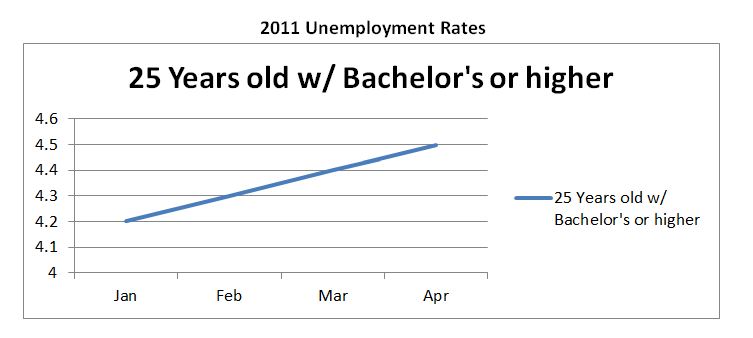
Our favorite barometer, the unemployed rate for those 25+ with a Bachelor’s or higher, remains at a staggering 4.5%.  This is one of those areas the BLS suggested showed improvement, but we don’t see it in the numbers.  This month we think it is appropriate to break this down a little further:

Eligible job seekers: (Worse/Better/Unch refers to the total unemployment rate for the group identified)

  • All 16+: Worse
  • Teenagers 16-19: Better
  • Men 20+: Worse
  • Women 20+: Worse
  • White: Unch.
  • Black: Worse (and worst in group; since Mar. 15.5%, 16.1%, 16.2%)
  • Asian: Worse
  • Hispanic: Worse
  • 25+
    • Less than a H.S. diploma: Worse
    • H.S. diploma: Better
    • Some college or associates: Worse (up.5% from April to 8.0)
    • Bachelor’s or higher: Unch.

Average weekly hours worked and overtime remained flat and the number unemployed for more than 27 weeks increased.  Health, education and social services remain the bright spot but that is roughly analogous to a firefly in the middle of a corn field on a cloudy night..during a lunar eclipse.  There is a lot of additional data that could be cited but we think we get it.

Anyone truly surprised by this data is either not paying attention or has achieved “expert” status.  GDP was just revised downward (as Blue World has been telling us it would), the currency is weakening (as Blue World has been telling us it would), and inflation is becoming an ever-increasing problem (as Blue World has been telling us it would), so let’s dispense with the contrived shock and awe, innocent ignorance, blatant stupidity, and dishonest analysis and opinion, shall we?  What our elected officials are doing is not working.  There is no crime in that.  The crime comes when the elected officials see it isn’t working and refuse to change course.  When it’s this bad everyone can see it.  Everyone can also see there is no sign of a shift in policy.  Thinking folks have no choice but to assume an elite few have it just the way they intended.

As always, we appreciate the time you take to read us.  Please, stay tuned…

Release Site: www.bls.gov

Every effort is made to ensure accuracy of data transcription but accuracy cannot be guaranteed.  The official release site should be cross referenced.  The analysis represents the opinion of Blue World Asset Managers, Ltd. who does not warrant or guarantee predictions based on its analysis.

© Blue World Asset Managers, LTD Friday, June 03, 2011

Blue World Employment Situation Summary 05-06-2011

Release Date:  Usually the first Friday of each month
Release Site: www.bls.gov
Market Sensitivity: VERY HIGH
Management Value: VERY HIGH

Friday, May 06, 2011

Brain surgery is not rocket science to a brain surgeon

 Extra, Extra, Read all about it: Jobs Report Surprises Experts!!!

 An ugly duckling with no swan in sight.

 I hate to rain on the “expert’s” parade but the jobs report is not good, it is not mixed and it is NOT a surprise.  The employment report is bad.  Period.    We predicted Wall Street would get past the headlines and into the detail shortly after lunch.  They did. 

An optimistic estimate is that about 1.5 million jobs have been added over the last year or so.  Conservatively, that puts us about 7.5 million jobs behind where we were before the crash.  This is not a recovery profile.  It is the (predictable, mind you) profile of an economy bouncing along the bottom waiting for something to send it toward the surface.  Unfortunately, there continues to be no catalyst for any bump in demand and, therefore, no reason to hire at the rate required to improve the overall picture.  On the contrary, some of the problems we’ve been saying were laying in the weeds for the last year are starting to poke their heads up and make some noise loud enough for even the “experts” to hear.  Most notably, of course, is inflation.  If things cost more to make and more to transport eventually they’ll cost more to buy.  The cost of food and fuel, you know the stuff that the “‘experts” say we shouldn’t count in inflation, will drive the cost of everything sooner or later.  For us it’s sooner but even the “experts” seem to be catching on, lately.  But there’s a double whammy.  Just to make sure inflation has a friendly environment to thrive in the Fed (big collection of “experts”)  decided to buy some debt (effectively borrow money from itself) with printed money.  That’s important; not money created by increased GDP and productivity.  It was new money essentially photocopied to buy loans made to us by us.  That dilutes the value of a dollar so, by default, it takes more of them to buy things = inflating prices.  The en vogue, sexy term is “Quantitative Easing”.  When inflation didn’t kick up fast enough they decided to do it again.  This time they gave it an even catchier moniker: “QE2”.  We’ll just call it “dumb and dumber.” 

 To the numbers, then…

We added 244 thousand paychecks and the unemployment rate went up to 9.0%.  This is the volatile labor force size phenomenon we have been describing for the last few months. 

 Most of you know our MVS (Most Valuable Stat) is the unemployed rate for those 25 years old and older with a 4-year college degree, or higher.  Their unemployment rate for April was 4.5%.  That’s bad enough.  The 2011 trend is very unsettling.

 There were 244 thousand private sector jobs added but the number of persons unemployed for less than five weeks rose by 242 thousand.  Those are new job losses.  That is an ominous sign, especially in light of the current “slow-down.”

The number of people working part time because they could not find full time employment increased and the number of marginally attached and discouraged workers (leaving the labor force) is on the rise, again.  Total weekly hours worked and overtime in manufacturing, both indicators of demand, fell slightly even though there is some pant-wetting over modest payroll increases.  This month’s increases follow a recent pattern that is grossly flat. 

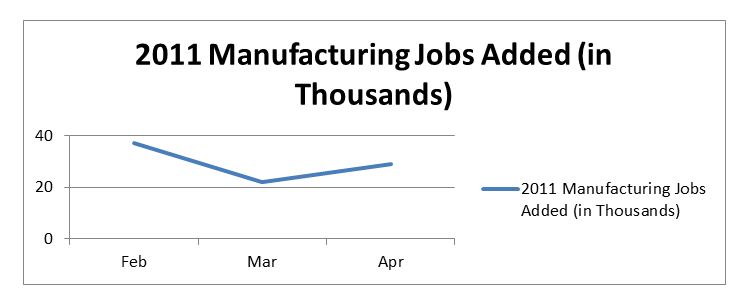
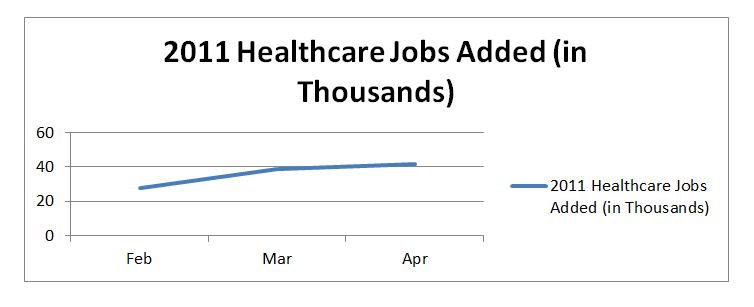
While the Establishment Survey has some bizarre looking spikes and dips, hospitality, retail, and healthcare showed the strongest gains.  Of those healthcare is the only segment that demonstrates a stable positive trend in hiring although the monthly gains are uninspiring at just fiver figures.


There are several more numbers that help round out the same story.  For a closer look please follow the link at the top or bottom of the page to the official BLS release site.  In the mean time we say keep that defense on the field of investing whether that field is buying stock, hiring employees or anything else that real people who invest real money do.  We’ll be content to let the “experts” continue theorizing from their cubicles and getting surprised when real data generated by the rest of us inconveniences their brilliance!


Thanks for reading and, please, stay tuned…


Release Site: www.bls.gov


Every effort is made to ensure accuracy of data transcription but accuracy cannot be guaranteed.  The official release site should be cross referenced.  The analysis represents the opinion of Blue World Asset Managers, Ltd. who does not warrant or guarantee predictions based on its analysis.