Blue World Employment Situation Report Analysis 10/07/2011

Blue World Employment Situation Report Analysis

Release Date:  Usually the first Friday of each month

Release Site: www.bls.gov

Market Sensitivity: VERY HIGH

Management Value: VERY HIGH

Friday, October 07, 2011

Brain surgery is not rocket science to a brain surgeon©

Well, folks, you can be disappointed all you want but if you’re surprised you haven’t been paying attention (or at least not reading Blue World.)  The report is another bad one and that can’t come as any bigger surprise than the prior several months.  Costs remain high, consumers are unemployed and, as of September, manufacturing workers are making no more money than they did in the summer.  This keeps demand low and businesses cautious.  Help on the horizon?  We think not.  The so-called “Jobs Bill” being promoted by the White House (and avoided by Senate Democrats) is a stimulus bill with a new name because “stimulus” has justifiably become a dirty word.  Are there some tax reductions in the bill?  Yes.  Are tax reductions good?  Usually but not when they are insignificant window displays in front of a warehouse full of bad policy.  One-off tax breaks cannot improve demand or bolster optimism when used as gimmicks and enticements for what is otherwise an anti-private-sector-business-for-profit philosophy.  That’s true no matter which party tries it.  The people who invest real money and hire real people won’t fall for that nonsense.  They have too much real capital at risk.  Tax reductions only matter when they are the instruments in validation of a complete business-friendly platform.

The numbers?  O.K.  You asked for it.

The overall rate was unchanged at 9.1%.  If that now seems like GOOD news we are in a lot of trouble.  Below the headlines we find the unemployment rate for those 25+ and holding a Bachelor’s degree or higher remaining in an unacceptable range between 4.1 and 4.5%.  Table A-15, Row U-6 showing the total unemployment rate including marginally attached and discouraged workers rose from 16.2% to 16.5% on a seasonally adjusted basis (summer jobs ending, for example.)  Those unemployed for less than 5 weeks and more than 27 weeks also increased.  That is bad news at both ends of the bookshelf especially when considering those working part-time for economic reasons (not enough work or could only find part time employment) also rose.  Some are trying to spin the addition of part-timers as a good thing.  The problem is WHY they are part time.  It is not an indicator, in this case, of rising employer optimism.  That’s also how the ADP report can be deceptive when using it to try to predict the BLS report.  The ADP counts payrolls not people and jobs.  One person with three part-time jobs can look like three “new” jobs even though only one worker is employed.  The average manufacturing hours worked and wages earned were flat and layoffs were announced that have not hit the numbers yet.

 We keep saying it and it continues to be validated.  Policy matters, and these are bad.   Sometimes it’s no fun to be right.    

Thanks for reading and, please, stay tuned…

Release Site: www.bls.gov

Every effort is made to ensure accuracy of data transcription but accuracy cannot be guaranteed.  The official release site should be cross referenced.  The analysis represents the opinion of Blue World Asset Managers, Ltd. who does not warrant or guarantee predictions based on its analysis.

© Blue World Asset Managers, LTD Friday, October 07, 2011

Blue World Employment Situation Report Analysis September 2 2011

Blue World Employment Situation Report Analysis

Release Date:  Usually the first Friday of each month

Release Site: www.bls.gov

Market Sensitivity: VERY HIGH

Management Value: VERY HIGH

Friday, September 02, 2011

Brain surgery is not rocket science to a brain surgeon©

Mr. Obama’s jobs plan better be a jobs plan that includes excluding the government from any further “help.”  We already know we are going to hear about “stimulus” without calling it “stimulus.”  We are going to hear about “shovel-ready” without calling it “shovel-ready.”  We are going to hear about infrastructure, green, tax credits for hiring, etc.  The content of this jobs address has already been leaked and, unless you suffer from Alzheimer’s, the ideas being touted as new are not new.  In all fairness we can at least say euphemistic renovation of politically toxic buzz words won’t do any harm.  The fear must be that the proposed double-down will get implemented.  This is no longer theory, friends.  We have the original forecasts recorded.  We have a data pool deep enough for analysis and that analysis exposes unmistakable trends.  Those trends are bad. 

We don’t care what works as long as it works.  By “works” we mean an economy that is in aggressive growth mode with rising GDP, falling unemployment, increased productivity, increasing personal wealth and ever-rising optimism and morale that encourages an environment driven by personal responsibility and motivated by the idea that reward will be determined by effort.  In spite of some “experts'” proclamations to the contrary we have concluded that government spending and extended unemployment benefits will not promote those objectives.  We also maintain the administration’s definition of “works” differs from ours.

The Devil is always in the details.  We can begin with the downward revision of last month’s job gains.  The headliner rate remained at 9.1%.   The number of new jobs added; zero.  That means none lost (net) either.  Already some “experts” are saying “that’s great”, “it got no worse”, “we’re obviously turning the corner” and similar nonsense.  We’ve been reading this report for a long time, folks, and we’ve never seen “0” at the end of that table.  That, alone, is unsettling.  There are, however, some noteworthy and ominous signs in the numbers.  Those over 25 with a Bachelor’s and higher remain at a staggering 4.3%.  Black workers’ unemployed rate jumped .8% overall with black men 20+ posting  a horrifying full 1% jobless rate increase from 17% to 18% July to August.  Those numbers are bad enough.  The most concerning to us is the following: Goods producing, construction, manufacturing, retail and I.T. all posted net job losses. That has not happened in a long time.  In addition, the number of hours worked per week and the hourly rate of pay had been on a long, steady, albeit, uninspiring rise.  They both fell in August.   

 Businesses should not and will not hire while under a dark cloud of government animosity, regulatory uncertainty, high unemployment, tanking consumer confidence and deplorable demand conditions.  A $20k per year employee costs a business double that to employ.  No competent business manager is going to think a $2500 offset to a $40k loss is an incentive to hire.  Only a forecast of improving demand is an incentive to hire.  The government produces nothing, brings nothing to market and is not dependent on customer satisfaction for survival.  Many in government seem to think the private sector works the same way.  Hint:  It doesn’t.

If you missed our post on The Confusion Suffered by “Experts” the link is below.  It describes some reasons why so many headlines contain words like “surprised”, “unexpected” “shocked”, etc.

 http://owl.li/6jNBf

 For us, our clients and our readers we remain defensive with our market investments and do not anticipate a change in that posture in the absence of any evidence of significant policy change. 

 Thanks for reading and, please, stay tuned…

 Release Site: www.bls.gov

Every effort is made to ensure accuracy of data transcription but accuracy cannot be guaranteed.  The official release site should be cross referenced.  The analysis represents the opinion of Blue World Asset Managers, Ltd. who does not warrant or guarantee predictions based on its analysis.

©Blue World Asset Managers, LTD Friday, September 02, 2011

The Confusion Suffered by “Experts”

Tuesday, August 16, 2011

Brain surgery is not rocket science to a brain surgeon.©

The Confusion Suffered by “Experts”

We are being asked a question pretty routinely lately.  In our Tweets and our blog posts we always exhibit an enthusiastic irreverence for certain economists, market commentators, media personalities and politicians by identifying them as “experts.”  We go on to explain why what they said was silly.  We have little use or respect for those whose headlines routinely contain words like “unexpected”, “surprised”, etc.  We often review our past posts regarding our opinions on where the economy is headed to make sure we have had a good handle on what is going on or if we need to shift our observational and analytical methodology.  Ya see, “experts”, that’s what you do if your analysis, decisions and policy aren’t working.  We are pleased yet sad to say if you follow us none of the economic data that “surprises” the “experts” is ever a bombshell for you.  This has led many of our readers to ask Why are the “Experts” Always Wrong?

There are several reasons ranging from academically focused and financially motivated to politically goaded.  In other words we must always consider the source.  The financially and politically motivated crowd is, we believe, reasonably small.  Advocates of the party in power will try to up-spin data and market beneficiaries have a vested interest in making any news look as good as possible.  That leaves a much larger group that is just plain wrong.  Why are these “experts” so easily misguided by the same data we review?  We have a theory.  The problem is mostly academic.  Blue World employs people.  Blue World principals and network resources employ lots more people.  Blue World clients employ lots, lots more people.  Decisions on how many are employed is partially based on a comprehensive review of the economic data released, just like many of our “experts.”  The difference is we HAVE EMPLOYED REAL PEOPLE and INVESTED REAL MONEY to make businesses (our own and our client’s) successful in the private sector.  We don’t just sit in cubicles and read data.  We compare the data to what we see happening around us in the real world.  Just driving  around town or across the country and taking note of strip mall vacancies can give some great anecdotal corroboration or refutation of the spin in the headlines. 

Data is just that.  Data.  It should be used as a metric against which to measure reality.  If we don’t understand how the data is gathered we are likely to make poor decisions based on it AND be at the mercy of those who do know and choose to ‘spin.’  For example, the unemployment rate dropped .1% last month.  Good news, right?  Not if we know how to read the report.  The number of unemployed people actually rose but the sample size changed such that the number of people being counted shifted. This created an artificial improvement the percentage even though reality worsened.  This is an observation, not an accusation, but I’m afraid there is a degree of estimating that goes into the BLS Unemployment numbers, and that creates the opportunity to mislead at the headline.  That’s why Blue World does the monthly analysis, to remove the spin and provide actionable intelligence to business owners, managers and investors. 

Another example: a great deal of predictive emphasis is placed on the ADP job numbers.  As the largest payroll processor in the company it is assumed that an increase in processed paychecks equals positive private sector job growth.  The problem is that ADP counts all payrolls, not all workers.  In other words one worker may be holding down three part-time jobs because he can’t find full time employment.  This looks like three new jobs but it is only one person working!  This statistic is not accounted for in the ADP report but is in the BLS release.  It is called “Employed Persons at Work Part-Time for Economic Reasons.” “For Economic Reasons” means a worker wants full time work but can’t find it.  It is found in Table A: Household Data of the monthly BLS report.  If we see a rising trend in the ADP report and want to deduce good or bad news from it we must compare that to the trend of part-timers for economic reasons.  If that trend is also rising we don’t have a good trend for private sector employment.

We did a blog some time ago that shows how all of the economic reports out there have just one common goal.  They all seek to determine what our mood is.  That’s really it.  The full post is entitled Is There a Meaningful Economic Recovery Going on Out There? and can be found at http://ow.ly/4M2Dn It shows what we predicted for the economy over a year ago.  Sometimes it’s no fun to be right.   The most relevant passage to this post follows:

Now, there are boatloads of economic releases that come out each week, month, quarter, year.  There is GDP, the unemployment report, housing starts, consumer confidence index, new home sales, existing home sales, new housing permits, first-time jobless claims, factory orders, manufacturing index and on and on and on… What I want you to realize is that for all the data gathered, analyzed and reported on they all have just one common objective.  It is to see what kind of mood you and I are in as consumers.  If we can determine what kind of mood the consumers are in and what their spending patterns are we can predict which way the economy is likely headed.  If unemployment is headed down, personal income is increasing and GDP is rising it is a darn good bet that good times are-a-comin’.

Often times spin of the data is used to try to shape our mood rather than identify it.  Those who read the detail (or our analysis) are inoculated against such manipulation. 

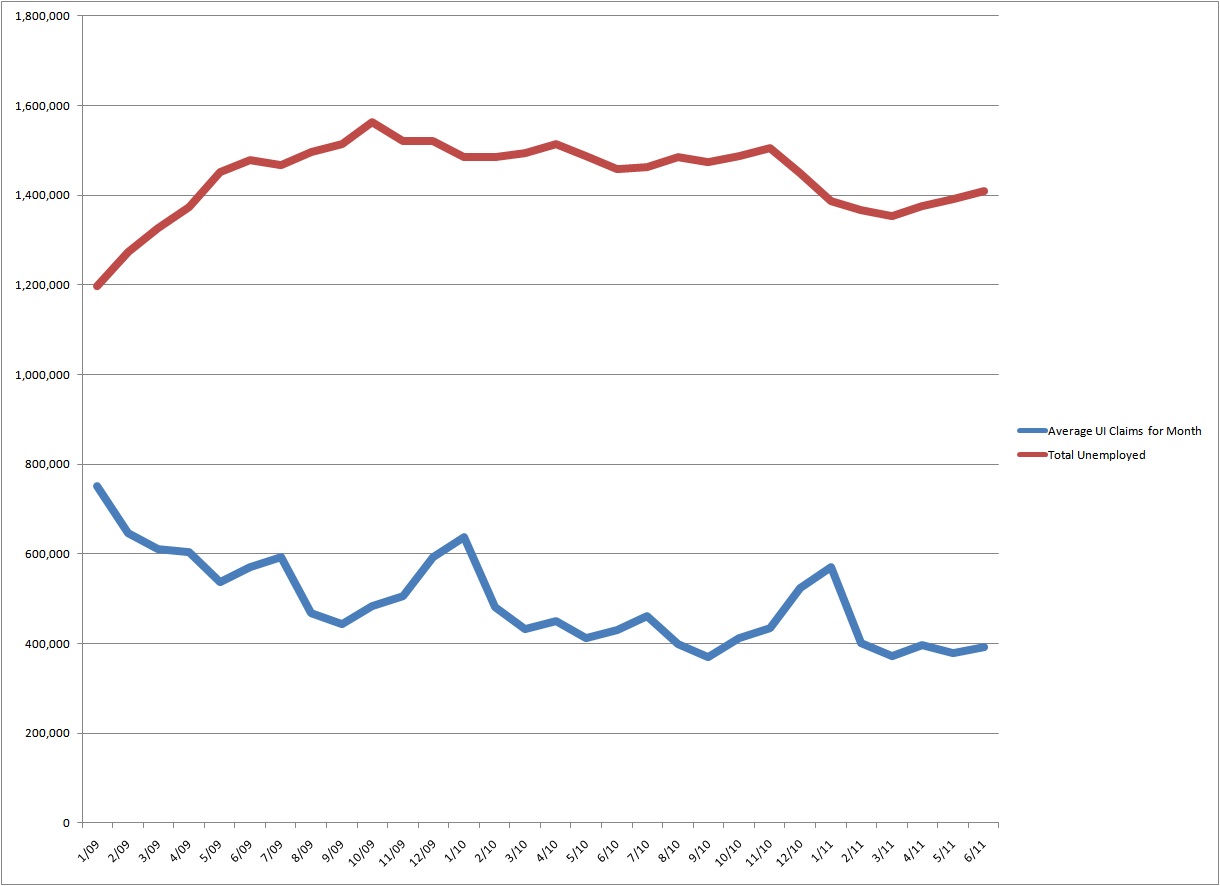
So how are the truly unbiased “experts” fooled?  We have data that comes out weekly, like first-time unemployment insurance claims; monthly, like the Bureau of Labor Statistics (BLS) employment report; and quarterly, like the Gross Domestic Product (GDP) report.  All too often our “experts” use the weekly type releases as predictors of the longer term data.  The correlation during robust recovery and distinctly weakening times can be quite good.  At times of bouncing along the bottom or flying at cruising speed, however, the predictive value predictably deteriorates!  If all you do is sit in a cubicle and look at data (like our “experts”) you’re just going to be wrong due to the inconsistent and sometimes volatile nature of the more short term data.  To illustrate this point the graph below shows the average number of new unemployment insurance claims (weekly) graphed against the actual number of reported unemployed people (monthly) divided by 10 to match the scale. 


Source: www.bls.gov & www.dol.gov

As you can see, if you were to use even the weekly average new claims (blue line) to predict the unemployed totals (red line), you would regularly be “surprised.”  If you were to look for news, good or bad, in the actual weekly numbers you can appreciate that they are even more volatile and unpredictable than the smoothed-out average represented above.  That’s why we roll our eyes and shake our heads when the markets throw a party or a wake every Thursday when the new unemployment insurance claims are announced. 

Any one week, month or quarter’s data does not tell us anything in a vacuum.  Convincing medium to long-term trends coupled with real-world observations ranging from personal income and internal sales to store front vacancies and the mood of our neighbors are the only way to accurately assess the true health of the overall economy.  This type of ongoing observation and analysis of DATA AND THE REAL WORLD is the only way responsible investors, employees, managers and owners (remember that managers and owners are also employees) make decisions about their businesses.  We say brain surgery is not rocket science to a brain surgeon. I am certainly neither.  But even I can predict 9% unemployment, record foreclosures, rising food and gas prices, historically low interest rates, unfathomable Federal debt, ubiquitous commercial vacancies and an ever-weakening dollar do not add up to a recovering economy!  This is why I, and I suspect you, will NEVER be an “expert.”

© Tuesday, August 16, 2011Blue World Asset Managers

 

Jobs Report Analysis August 5 2011

Employment Situation Summary

Release Date:  Usually the first Friday of each month

Release Site: www.bls.gov

Market Relevance: VERY HIGH

Management Value: VERY HIGH

 Brain surgery is not rocket science to a brain surgeon.©

 Friday, August 05, 2011

 Blue World Employment Situation Analysis


We say this analysis is not about headlines and spin.  Sometimes it’s an easy thing to write and sometimes painful.  Like today.  The details of the report do not support the notion that the labor market is improving.  On the contrary.  The idea that it’s good to have 117k new jobs vs. an expected 75k in and of itself is an indication that things are bad.  In truth, the size of the civilian work force got smaller, the participation rate fell, the number of employed people fell and the number of people not in the labor force rose.  All this combines to produce an unemployment rate that is flat but will be touted as an improvement by many.  GDP was poor and revised down, mass layoffs have been in the news in that last week and on the rise, consumer confidence and CEO confidence is down, earnings are very mixed and outlooks are weakening.  All of the indicators affirm the lack of recovery and we have an economy still on the ropes.

 The markets opened with the predictable knee-jerk but at the time of writing exuberance is waning as the details of the report make their way into the collective awareness.

 Some Numbers:

25+ with a bachelors and higher is still above 4%, and those working part-time for lack of full-time availability is up.  Average hours worked and overtime in manufacturing was flat at 41.4 and 4.1 hours per week, respectively.

 As we continue to observe, policy matters.

 We remain in a very defensive posture with our investment strategies and will for the foreseeable future.

Thank you for reading and…stay tuned!

Release Site: www.bls.gov

 Every effort is made to ensure accuracy of data transcription but accuracy cannot be guaranteed.  The official release site should be cross referenced for accuracy and footnoting.  The analysis represents the opinion of Blue World Asset Managers, Ltd. who are not giving advice and does not warrant or guarantee predictions based on its analysis.

 ©Blue World Asset Managers August 2011

Non-partisan, Experience Driven, Response to an Article by a Partisan Accusing Partisans of being Partisan

Tuesday, July 26, 2011

Ignorance is Curable. Stupid is Forever©

Non-partisan, Experience Driven, Response to an Article by a Partisan Accusing Partisans of being Partisan

Please read http://owl.li/5Nb6g

Our response follows:

Paragraph I:

The author suggests that uncertainty is a “bogus” reason for the failure of the economy to rebound.  That means uncertainty must be a “bogus” reason for businesses not to hire, right?  This “bogus” excuse, he says, is used by the right and business.  Does he believe that only those on the right can be business owners OR that left-leaning business owners are hiring at warp speed and the left side of the economy is booming?  Ya see, we analyze the economic reports each month and we can say with confidence he’s wrong, either way.

Paragraph II:

The uncertainty is certainly NOT political.  It is, however, based on another word starting with “p.”  The correct word is “practical.” 

Paragraphs III & IV

We’ll ignore the lunacy of the statement regarding “appropriate regulators” and move on to the really mentally challenged comparison of implementing current legislation to administering tax cuts and Medicare benefit additions.  The implementation of tax cuts is already understood in process and simple in form based on the IRS’ experience with increases, decreases, and even rebates.  Medicare is an existing bureaucracy whose main problem has always been the absolute knowledge of how to add benefits.  Using Dolt-Frankfurter (ok, Dodd-Frank) and healthcare reform as comparisons for implementation is similar to saying a pre-school child should be able to perform diagnostic and repair work on a semi because he’s played with a Tonka truck.  The former Speaker of the House said the four thousand page health reform legislation had to be passed in order to find out what was in it. http://owl.li/5Nd4K (video) The Representatives and Senators who voted for it admitted not reading it.  Senator Baucus said (with a chuckle, no less) even if Senators read the bill he could not certify they could understand it! http://owl.li/5Nep8 (video)  Dodd-Frank is twenty-seven hundred pages plus in its own right.  A year after passage the regulators, not the right and business, are the most frustrated with it because no one, including the authors, understands it well enough to write the new rules or even have a blueprint for implementation.  There is, certainly, no experiential template. http://owl.li/5Ndls    A year later as the first changes were to take effect it is estimated that eighty to ninety percent of the rules are still unwritten, stretching the responsible agencies beyond their limits. http://owl.li/5Nf1O   Many deadlines have been postponed indefinitely in spite of President O’s obvious affection for imposing unmanageable shot clocks.  How long did it take to receive your Bush tax rebates or for Medicare to start paying for your prescriptions once passed? 

Now, do we really need to talk about the absurdity that business owners and people experienced in the investment of real money and the hiring of real people should not have the right to challenge the regulations set forth by pencil pushing bureaucrats who’ve never risked a dime or signed a paycheck and, by the way, were the real authors of the financial crisis to begin with?  << Read why at http://ow.ly/4M2Ac >>  Does the author really believe that legislation should just be accepted without challenge or question to avoid uncertainty?  Doubtful.  We’re reasonably confident he doesn’t see litigation against things like the Arizona immigration law, Defense of Marriage, Welfare reform, entitlement reform or tort reform fostering unnecessary uncertainty.  Lawsuits to challenge the legislation are the source of uncertainty?  PLEASE! 

Paragraphs V & VI

The differences between the parties ALMOST guarantees a shift in policy?  For the first time in our history a major piece of legislation was passed against the will of those our representatives were elected to represent.  That is policy change we can do without.  I know the arrogance of the party responsible.  They think they know what’s fair and they think they know what’s best.  They have forgotten we don’t care what they think.  They are supposed to respond to what WE think.  They have forgotten that they are our employees, not our rulers. 

Our author demonstrates he completely misses the point.  Anticipation of rising taxes throws a wet blanket on the mood of business and individuals and the expectation they are coming down encourages  investment and increased business activity.  How do we know?  Simple.  We own our own business and are in the business of working with businesses, business owners and leaders every day and have been since the Carter years. There is no longer any uncertainty when it comes to Obama and the current administration.  They are now a known quantity.  They are committed, ideologically and legislatively, to an anti-business, pro-government, pro-wealth redistribution philosophy.  That’s fine.  Many of us knew this before the election and many more have learned it since.  The administration’s problem is that they are in the minority. 

 Americans don’t want a socialist society and we are not confused by the ideological differences between the parties.  It’s just that every once in a while an administration like this one comes along and reminds us that policy is driven by ideology and policy matters.  The people who actually put capital at risk, employ workers and create opportunity are very certain they have no friends in this administration.  The uncertainty resides in the sweeping rule changes already passed but without clear lines within which to operate, the contemplated regulation throughout the agency alphabet soup, and the rhetoric regarding future restrictive and punitive policy.  What we are certain about is the intent of the administration.  The only uncertainty, which is more than enough to keep the economy in neutral, is how bad will it get.  Don’t oppose his re-election?  The prospect of four more years?  Now that is a terrifying uncertainty!