A Flute With No Holes Is Not a Flute and A Recovery With No Jobs Is Not a Recovery.

Friday, October 12, 2012

Ignorance is curable. Stupid is forever.©

 

In our jobs report analysis last week we said what we’ve been saying for a long time.  We are not in a “recovery” because there is no such thing as a “recovery” without an expanding labor market.

So, what should a recovery look like?

Several of you e-mailed or called and pointed out that we’ve been demonstrating what a recovery doesn’t look like, but we haven’t really shown what a real recovery does look like. EXCELLENT POINT.  Thank you!

We dropped everything else this week to do the research, compile the data and generate the graphs so you can compare this “recovery” period to those of the past five recessions going back to 1973.

A true economic recovery following a recession necessarily features an expanding labor market.  An expanding labor market consists of two key elements.  One is the number of people reporting as available to work (the civilian labor force) and the other is the number of the civilian labor force members that have a job (total employed).   In order to be in a recovery BOTH of those groups need to demonstrate expansion.

7.8% is not credible because…

As we discussed last week, no one finds a .3% drop in a single month to be credible.  With over 12 million people out of work, 100,000 new jobs just can’t move the needle like that.  Heck, a couple of months ago an increase of 163,000 jobs (since revised lower) sent the unemployment rate up!  How can this be?  Without going into the detail, it is very simple arithmetic.  If the growth in new jobs outpaces the growth of the civilian labor force the percent unemployed will fall even though things aren’t getting better.  So, the labor market is not improving unless the unemployment rate falls in the face of an expanding civilian labor force AND an increase in the number of new hires.  Beyond that, it just doesn’t fit with all the other data out there.  For example, we need about 250,000 new jobs per month just to break even!  Our GDP is at 1.3% (about .9% if we take out inventories).  To get our unemployment rate down to 7.8% our GDP would need to have been about 4%.

Since last we spoke…

We are not conspiracy theorists, but come on…  Are we expected to believe the big upward revision in new government jobs was the portion that was slow to report?  Are we asked to forget that government jobs don’t signal private sector expansion?  We found out that the administration “secured” an agreement with Lockheed Martin to postpone layoff announcements until after the election.  On Thursday 10/11 an equally implausible drop in first-time unemployment benefit claims was trumpeted as the best in four years.  Hours later we learned that California’s count wasn’t included.  When we add that, the numbers aren’t so good and, of course, last week’s numbers were revised up.  Like we said last week, if these are the shenanigans we know about…

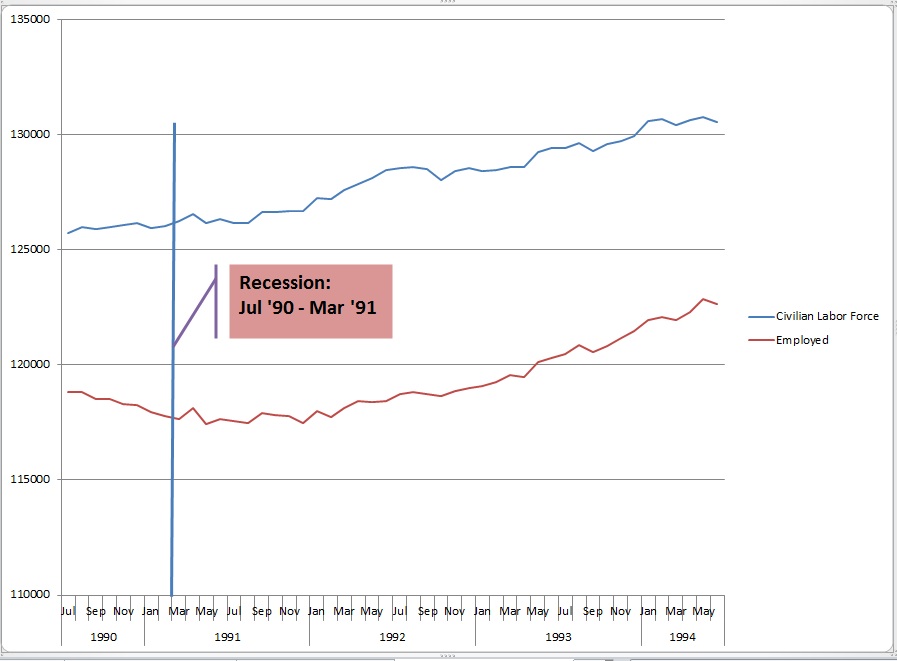
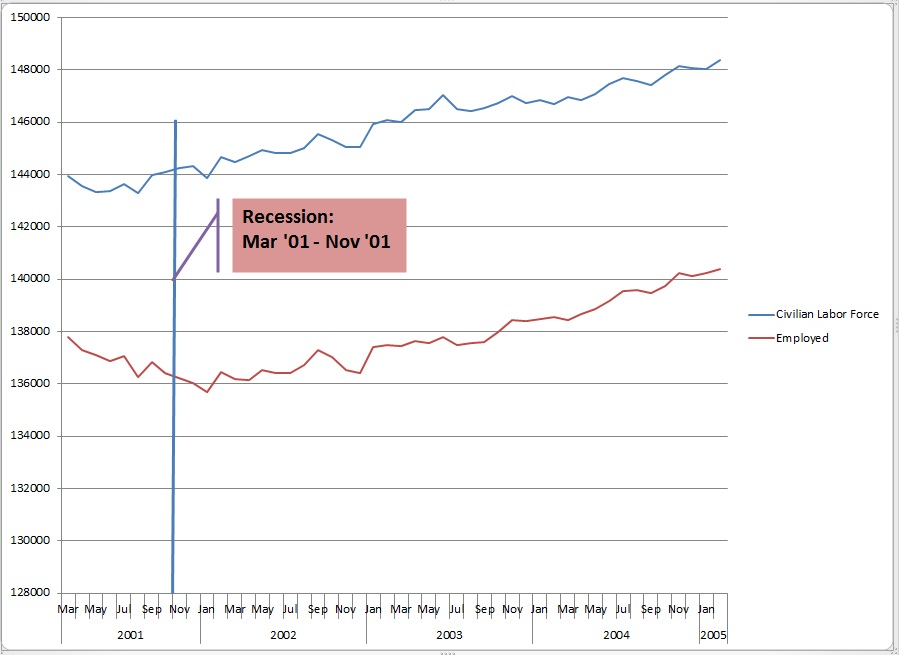
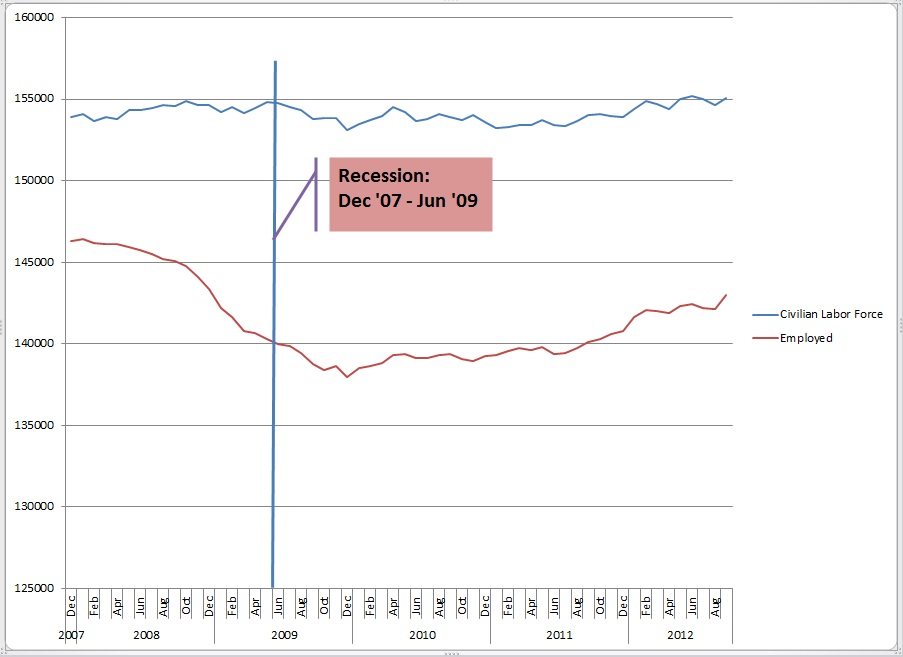
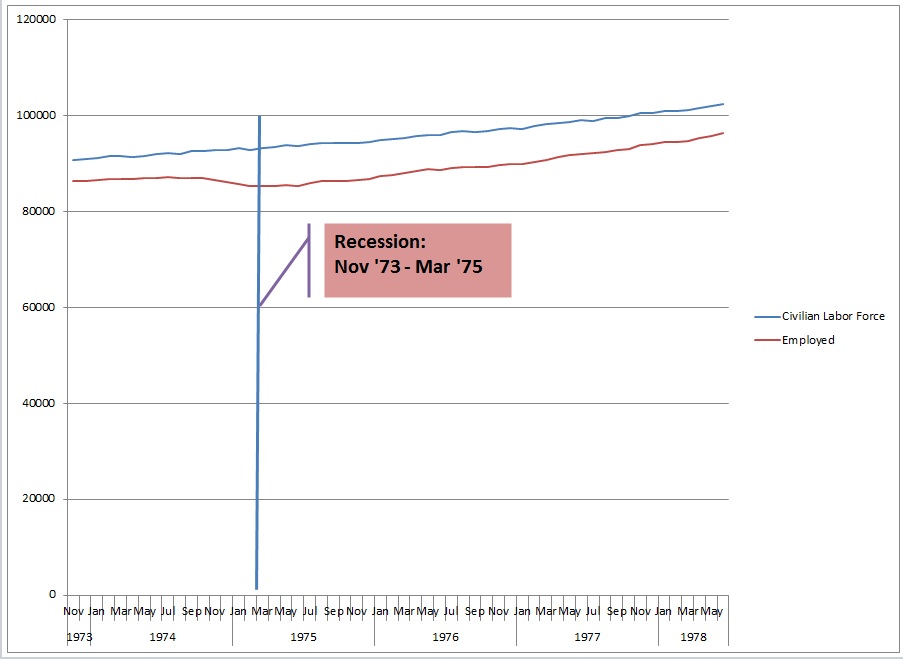
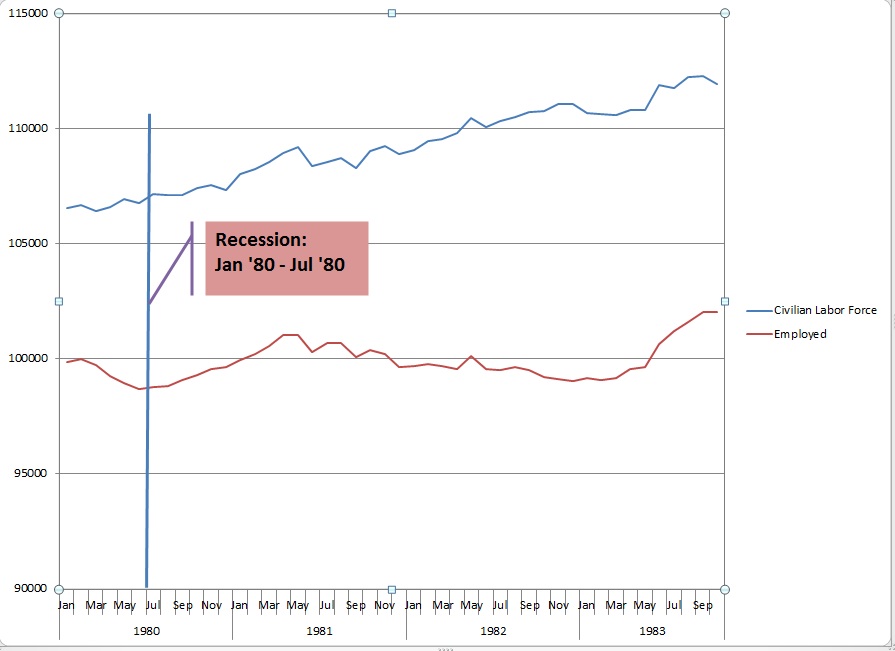
OK, so what does a real economic recovery look like?  Below are graphs showing the size of the civilian labor force and the number of employed people from the official beginning month of the recessions going back to 1973.  The graphs extend out for the first forty months of recovery following the official end of each recession which is where we are with the most recent September 2012 jobs report.

♫ ♪ One of These Things is Not Like the Others… ♪ ♫

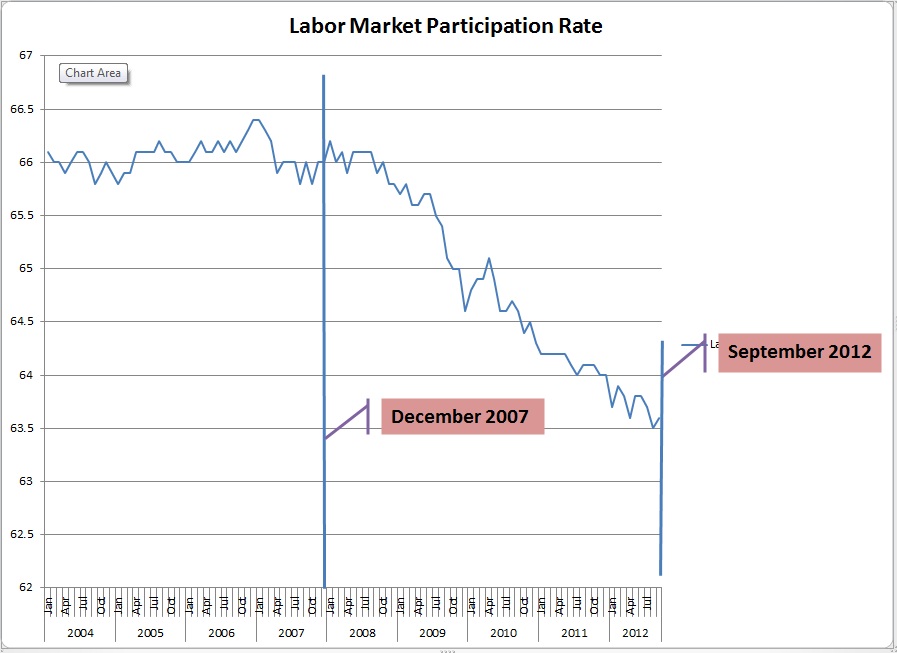
It makes sense for Big Bird to be a media headliner this week because our analysis is no more complicated than applying the Sesame Street Rule; One of These Things is not Like the Others!!  Please note the movement of the labor force size and the number of employed people.  The current “recovery” profile does not resemble any of the past 5 recoveries as the labor force size is flat.  That’s the key to the falling rate.  The final graph shows the participation rate.  As you will see the participation rate had been quite stable for the prior 4 years and then plummeted during the “recovery.”  This validates the graph showing virtually no material movement in the size of the labor force while jobs are added moving the lines closer together.  This gives us a lower unemployment rate even though the labor market is not improved.

All data for the graphs was acquired from the official Bureau of Labor Statistics historical tables which can be found at http://www.bls.gov/cps/cpsatabs.htm


This last graph shows the percentage of prospective workers who are actually participating in the labor market.  This is what is meant when you hear about all the people who have given up and left the labor market.


It’s striking.  Even the recessions that only last a few months demonstrate an increase in labor force size.  It has never been stagnant like it has been for the last forty months!

So, comparing this recession-recovery period with the previous five indicates a dramatic difference between the profiles.

Someone could tell us that this “recovery” is a flute.  If we didn’t know better we might believe it.  We could repeat it.  We could even broadcast it.  But even Big Bird would never be able to blow hard enough to make music with it…because it’s not a flute.

As always, thanks so much for reading.  We hope you enjoyed it and stay tuned…

Every effort is made to ensure accuracy of data transcription but accuracy cannot be guaranteed.  Referenced sources should be reviewed.  Any analysis represents the opinion of Blue World Asset Managers, Ltd. who does not warrant or guarantee predictions based on its analysis.

©Blue World Asset Managers, LTD Friday, October 12, 2012


How About a Little Economic Reality Check?

Thursday, September 20, 2012

Ignorance is curable. Stupid is forever.©

How About a Little Economic Reality Check?

As we watch the markets struggle with the Fed action and economic data this week, we thought we’d offer a quick summary of what’s really happening out there…and it’s not good so watch your money!

The Fed opiate QE3 is fading a bit and some economic data are taking the lead causing our market “experts” a bit of bi-polar disorder.  Watching the market intraday charts shows a market that is looking for any excuse it can find to rise.  That’s not a safe or sustainable environment so keep the defense on the field.

We cannot emphasize this point enough.  At Blue World we make a very important distinction between “data” and “actionable intelligence.”  Data is what the market “experts” react to each day as each weekly, monthly or quarterly economic report hits the wires.  This is, simply, foolish.  That’s why “experts” are such slaves to data.  One data point is useless out of context.  Trends are what matter.

Actionable intelligence is what we glean when we look at the trends of each report and {this is the important part} compare them to the trends in all the other reports plus the trends in our industry plus the trends we see in our own business each and every day.

Below we are providing links to summaries of the economic data released this week (week of 9-17-2012).  Read the summaries if you’d like but what we want you to study are the graphs.  You’ll find that when you add them all together you’ll get a much more complete picture of what’s really going on in the economy than you will by reading the headlines or even the summary of any one week or month’s report.

Starting Monday of this week we got the Empire State Manufacturing Survey and it was dismal, joining the overall trend in manufacturing..

On Tuesday we got:

Goldman Same Store Sales The report showed a drop in sales for the month and that is predictable as the back-to-school rush passes.  Take a look at the graph, however, and you can see that if you imagine out the wild volatility you see a retail sales trend that is totally uninspiring.  Ok, so how does that stack up with other reports?

Redbook which is as likely as not to confirm the Goldman report agrees this week.  More important, look at the long term trend and it is remarkably similar to the Goldman chart.  Both are lackluster, at best.

Housing Market Index What do you think people who make a living building houses and are still in business are going to be inclined to say when asked “how do you feel about the home building industry?”   The chart says it’s on the rise! YIPPEE!  Wait! The anecdotal optimism survey of builders needs to be compared to other housing data.

Wednesday gave us some more figures to consider.

Mortgage Bankers Association New Mortgage Applications This report is considered a predictor of future activity in residential real estate because people need mortgages to buy a house.  See if this chart matches the builder’s optimism chart above.

Housing Starts Starts were up a little in 2011 and very shallow to flattening so far in 2012.   Compare the “recovery” period graph to the steepness of the drop in 2008-09.  This is not what a recovery looks like.

Existing Home Sales While up in each of the last two months, two months is certainly not enough to establish a trend especially as interest rates drop to generational lows and values have plummeted causing a predictable blip. This plus the MBA Applications plus the Existing Home Sales data does not demonstrate a robust real estate recovery underway.

You know it’s Thursday when the unemployment insurance claims from the prior week are revised up!

Jobless Insurance Claims Last week’s numbers were, of course, revised higher and the moving average is up.  Regardless, this report has proven to be a relatively unreliable predicator of the official monthly unemployment report so we regard the weekly knee-jerk reaction to this report as utter silliness.

Consumer Comfort In the summary they used the word “brightening.”  Just have a look at the graph that is not only depressingly low but, also, making lower highs and lower lows, then let us know how “bright” you think consumer comfort really is!

Philly Fed Survey There was a huge one month bump in new orders (headline)…and it makes the index less negative. (not in headline) That’s the best that can be said based on this one report especially in the face of the Fed reports from last month (there is usually one that is better than the others) and the Empire report from just three days ago.

If you used today’s headlines to make decisions you’d be purchasing more inventories, hiring more employees and looking for a bigger facility.  Bad idea!

You don’t have to be an economist (“expert”) to figure this out.  As a matter of fact we have lots of evidence that not being an economist is a huge advantage in understanding reality!   You can read more about this in our posts:

 “The Confusion Suffered by ‘Experts’”

and

“The Confusion Suffered by ‘Experts’ II”

We can get a reasonably reliable picture of what’s really happening in the economy if we ignore the daily headlines and take a look at the economic data in total within the context of the short, medium and long term trends.  That is how we convert data into actionable intelligence.  That is how we non “experts” plan, predict and make decisions.


Every effort is made to ensure accuracy of data transcription but accuracy cannot be guaranteed.  Referenced sources should be reviewed.  Any analysis represents the opinion of Blue World Asset Managers, Ltd. who does not warrant or guarantee predictions based on its analysis.


©Blue World Asset Managers, LTD Thursday, September 20, 2012

Messin’ with Markets is More Dangerous than Messin’ with Sasquatch!

Thursday, September 13, 2012

Ignorance is curable. Stupid is forever.©

Messin’ with Markets is More Dangerous than Messin’ with Sasquatch!

Time to Roll Up a Newspaper and Smack the Market “Experts” on the Nose!

GDP is below 2%.  Claims for unemployment benefits are up and get revised higher every week.  A record number of Americans are on government assistance.  Social Security and Disability benefits hit record highs with a full month left in the fiscal year. Consumer comfort, confidence and sentiment are low and falling.  Investor confidence is weak.  Manufacturing is contracting.  The Eurozone is on the brink of financial collapse.  Our national debt is over $16 Trillion. Foreclosures are high and rising.  Terrorists are attacking U.S. Embassies around the world and murdering Americans.  And unemployment is over 8%…for over 40 months…yet, somehow, the Dow is up over 200 points on 9/13/2012 because the Fed announced QE3?

It should be of tremendous concern to everyone who has investments in the public markets that market performance has become SO dependent on government action.  Do you realize that the actions contemplated by governments have become more important to the public markets than business fundamentals?  Governments don’t even have to do anything.  All they have to do is hint that they might do something, and the markets go crazy.  It may be a suggestion that the Europeans may bail out Greece, or it may be the U.S. Fed announcing a new round of stimulus, as is the case today.

Let us explain what Quantitative Easing is in simple terms, then decide if you want your investment nest egg tied to more of it.  In its simplest terms it is trading short term debt for long term debt.  It is the proverbial kick-the-can-down-the-road exercise.  The Fed uses our money (tax receipts) to buy back short term bonds (loans to the government) and refinance them for a longer term.  The massive buy-back causes a drop in interest rates that is expected to stimulate the economy.  It is the exact opposite of what they do during boom times when they think the economy is “overheating” and they want to avoid inflation by artificially raising the interest rates to slow things down.

Folks, we’re telling ya, messin’ with markets is more dangerous than messin’ with Sasquatch!  At some point this will have to revert to being about economic fundamentals.  When it does we recommend having the A-Team defense on the field or watch from the stands because it could be a catastrophe.

We can’t understand the exuberance at any level BECAUSE IT DOESN’T WORK, but we would think that the “experts” who get so giddy about such stupid and detrimental policies would have a learning curve that breaks off 180° somewhere.  After all, we have plenty of evidence that these measures don’t work in the face of the current economic environment.  You know what they say about the definition of insanity being the duplication of effort over and over yet expecting different results?  O.K.  the “experts” are not just morons, they’re insane.

For those of you wondering how we can make such assertions regarding the ineffectiveness of prior actions rendering the current ones “insane”…

GDP is below 2%.  Claims for unemployment benefits are up and get revised higher every week.  A record number of Americans are on government assistance.  Social Security and Disability benefits hit record highs with a full month left in the fiscal year. Consumer comfort, confidence and sentiment are low and falling.  Investor confidence is weak.  Manufacturing is contracting.  The Eurozone is on the brink of financial collapse.  Our national debt is over $16 Trillion. Foreclosures are high and rising.  Terrorists are attacking U.S. Embassies around the world and murdering Americans.  And unemployment is over 8%…for over 40 months…


Every effort is made to ensure accuracy of data transcription but accuracy cannot be guaranteed.  Referenced sources should be reviewed.  Any analysis represents the opinion of Blue World Asset Managers, Ltd. who does not warrant or guarantee predictions based on its analysis.

©Blue World Asset Managers, LTD Thursday, September 13, 2012

Employment Situation Analysis – 09-07-2012

Blue World Employment Situation Report Analysis

Release Date:  Usually the first Friday of each month

Release Site: www.bls.gov

Market Sensitivity: VERY HIGH

Management Value: VERY HIGH

Friday, September 07, 2012

Brain surgery is not rocket science to a brain surgeon©

The big question facing us this morning is “to graph or not to graph.”  This is one of the worst reports we’ve seen in a while, and that’s up against some pretty stiff competition.  The market silliness is always entertaining, and today is no exception.  The other data-driven graphs are just striking.

The July number was revised down significantly, and that’s consistent with what we said on CBS Radio last month. {Podcast at  http://owl.li/cJ3T1 – starts at 2:30 in} 96,000 net jobs is “only” about 30,000 short of the “expert” consensus, and that is just about the best news we can find no matter how deep we dive into the minutiae.

25+ with a Bachelor’s or higher are still unemployed at over 4%, which was a level unheard of since records have been kept…until the last few years.

The number of people not in the work force continues to balloon, and that’s why the unemployment rate has fallen or remained the same from time to time, not because the labor market is improving.

The work week remains flat overall, but it has fallen to its shortest duration of the year in manufacturing.  That’s not encouraging.  The really big news in this report, which won’t get much play but is very troubling, are the downward revisions to hourly and weekly pay totals in several sectors, including construction and manufacturing.

We’ve decided the graphs would just rub it in, and we have no desire to subject you to them.

Policy matters, folks.  Policy matters.

Thanks for reading, and please, stay tuned…


Release Site: www.bls.gov


Every effort is made to ensure accuracy of data transcription but accuracy cannot be guaranteed.  The official release site should be cross referenced.  The analysis represents the opinion of Blue World Asset Managers, Ltd. who does not warrant or guarantee predictions based on its analysis.

©Blue World Asset Managers, LTD Friday, September 07, 2012

Blue World Employment Situation Analysis 8-3-2012

Blue World Employment Situation Report Analysis

Release Date:  Usually the first Friday of each month
Release Site: www.bls.gov
Market Sensitivity: VERY HIGH
Management Value: VERY HIGH
Friday, August 03, 2012

Brain surgery is not rocket science to a brain surgeon©

163,000 new jobs vs. 100,000 expected!  WOO HOO, right?  Sorry folks, this report is the cap on a miserable month of data.  Why?  Here we go…

In the winter and spring we explained ad nauseum that the falling unemployment rate was an artificial improvement in the labor picture because we can’t make the labor market better by making the labor force smaller.  The uptick in the last couple of months is an indication of a deteriorating market but, as always, the details not the headlines tell us why: 

The Establishment Survey indicates 163,000 payrolls were added last month.  The problem is that the size of the labor force fell by 150,000 workers, the  number of those not in the labor force rose by 348,000, the number of employed people fell by 195,000 and, wait for it, the number of unemployed people rose by 45,000.  I’m afraid this just doesn’t make for a good report but, of course, there’s more.  25 years old and up with a Bachelor’s Degree or higher remain unemployed at over 4%.  The work week length, and consequently, overtime hours are not increasing and wage increases still lag inflation.

Other data for the month show GDP at a very weak 1.5%, which falls to 1.3% when we strip out inventories.  The regional Fed reports all have a common theme of contracting orders and evaporating inventories validated by a dismal factory orders report .  Productivity is down, unit labor costs are up, consumer comfort, confidence and sentiment are trending down, and the FOMC acknowledges the economy is slowing but isn’t ready to “act” yet.

Many institutions out there have an interest in trying to show the data in its most positive or negative light.  Since our job is to help businesses develop strategy based on the realities of the economy, we have to take the data as it is…and the data is negative.

Thanks for reading and, please, stay tuned…

Release Site: www.bls.gov

Every effort is made to ensure accuracy of data transcription but accuracy cannot be guaranteed.  The official release site should be cross referenced.  The analysis represents the opinion of Blue World Asset Managers, Ltd. who does not warrant or guarantee predictions based on its analysis.

©Blue World Asset Managers, LTD Friday, August 03, 2012